- Get link
- X
- Other Apps

The idea of a vacuum train was first expressed by Robert Goddard in 1909 in the journal Scientific American. He proposed to organize the movement of cars in a vacuum tube based on magnetic levitation. The first experiments in the world with the displacement of a body in a vacuum tube due to an electromagnetic field were put by the Russian professor Boris Veinberg in the 1910s. However, soon they were suspended because of the First World War. Subsequently, experiments were conducted in Germany, Japan, Switzerland and England, and in 2012 Ilon Mask presented the Hyperloop project, which is also still under development. In addition to SpaceX, Virgin Hyperloop One and Hyperloop Transportation Technologies are working to create a vacuum train. How the vacuum train will work - about this in today's issue!

Hyperloop is a closed overhead line in the form of two parallel pipes connecting at the end points of the route. Inside, in one direction single capsules 25-30 meters in length will travel at a speed of 480 to 1220 km / h. Traffic intervals according to the project will be only 30 seconds. Engineers developed two versions of the system - passenger and passenger-cargo. In the first version, the diameter of the pipe will be 2.2 meters, and the capsule will hold 28 people. In the second, it is proposed to use a pipeline with a diameter of 3.3 meters, and in capsules, in addition to people, place up to three cars.
It is worth noting that in fact Hyperloop is not completely a vacuum train. It is quite enough foraccacum (with a pressure of 100 Pascal), which is supported by moderate power pumps and the walls of a pipe made of ordinary steel with a thickness of 20-25 mm.
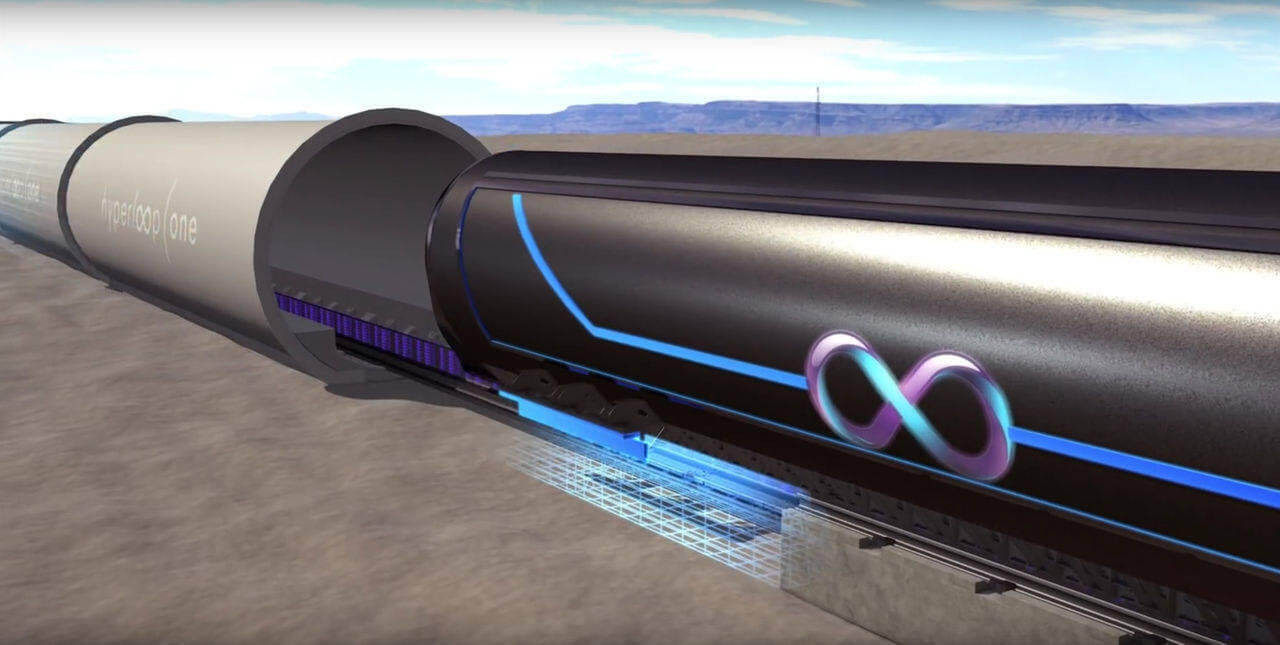

At the same time, according to calculations of the capsule at high speeds, all will be confronted with incoming air masses. They were decided to use to create an air cushion: located in the nose of the capsule nozzles will redirect the oncoming airflow under the bottom. Thus, there is no need to use a more expensive magnetic cushion.
The capsule will be driven by a linear electric motor. The stator is an aluminum rail with a length of 15 meters at the bottom of the pipe, which will be repeated every 110 kilometers. The rotor will be in each capsule, while the required constant power is only 100 kilowatts. Since the stator performs not only acceleration, but also braking, in the latter case the kinetic energy of the capsule will be converted to electric.
In the event of depressurization, an electric compressor will be provided in the nose of the capsule, which accumulates compressed air on board. In addition, the capsules will accommodate 1.5 tons of batteries, the charge of which is enough for 45 minutes, in case of interruptions with electricity to get to the nearest station.
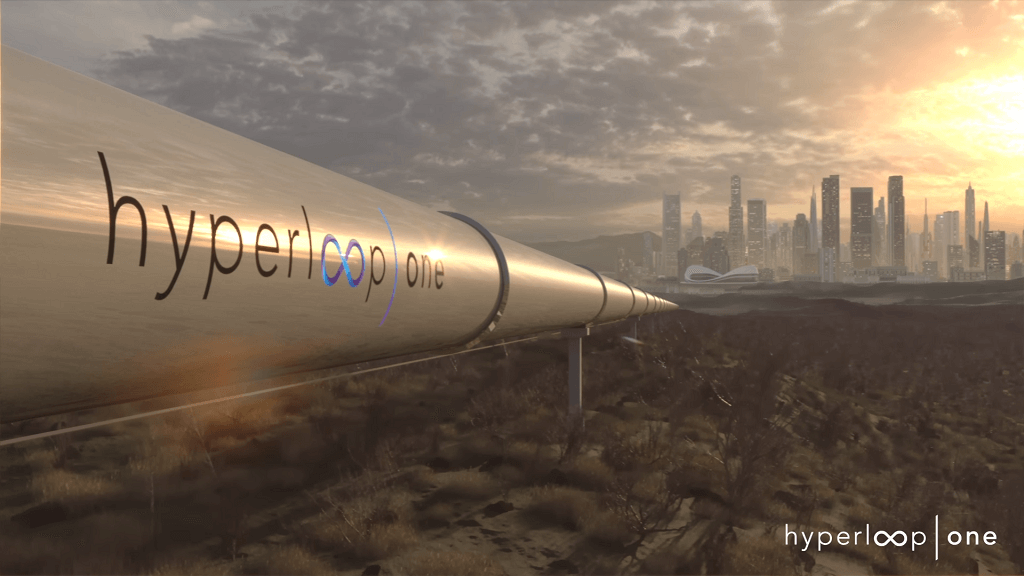
It is worth noting that Virgin Hyperloop One and Hyperloop Transportation Technologies are considering the possibility of using magnetic levitation instead of an air cushion, which will increase the cost of creating a vacuum train line, but will minimize possible management problems. This means not active levitation, as in the case of a maglev, but a passive one. It involves the movement of permanent magnets over the conductive surface.
Currently, there are active tests of vacuum trains by different companies. So in December last year, the Virgin Hyperloop One was able to disperse its capsule to a record speed of 387 km / h. The first lines of vacuum trains can appear in India, the United States, the United Arab Emirates and South Korea.
The article is based on materials .
Comments
Post a Comment