- Get link
- X
- Other Apps

The painting "Mona Lisa", written by Leonardo da Vinci, may be part of an ancient 3D image. Scientists have found that a copy of the portrait of Gioconda, located in the Prado Museum in Madrid is very close to the original, which hangs in the Art Museum of the Louvre in Paris. The analysis showed that if these pictures are superimposed on each other, a volume effect is created.
The fact is that the horizontal distance between the perspectives on which both paintings are built is 69 millimeters, which is approximately equal to the distance between the pupils of the human eye, which is 64 millimeters standard. Therefore, the combination of two paintings with the image of Mrs. Lisa del Giocondo gives a 3D-effect, writes the magazine Science News.
Perhaps the differences in the two works are due to the fact that a copy of Gioconda was written by a student practicing in the da Vinci workshop.
To recreate the setting in which the artists worked, researchers from the University of Bamberg in Germany calculated a perspective shift, taking the tip of the nose on two images as a guide. With the help of 32 observers, scientists visually determined the position of artists relative to the observed object (model) at the time of writing two paintings. The scene looked like this:
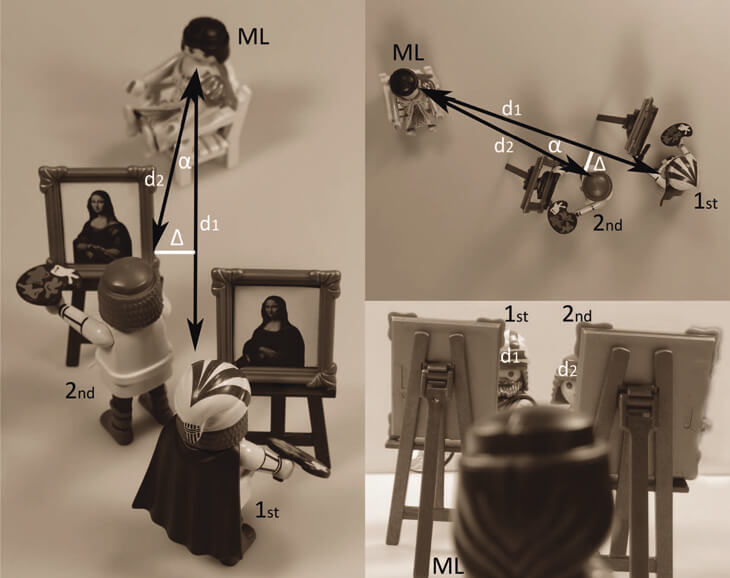
Leonardo da Vinci was on the right side of another artist and was removed from the model a little more. If they stood side by side, the shift in perspective would have been even stronger. The location chosen by the artists has minimized the distance between the perspectives for the two paintings, the researchers explain.
This is how 3D images are created. The human brain perceives depth by merging two images with a different perspective, coming from each eye.
The researchers skipped the electronic versions of the Mona Lisa picture through a light filter and obtained a stereo image for viewing through glasses with colored glass: red for the left eye, turquoise for the right. The stereo effect method is called anaglyph. In the image below you can see the result.
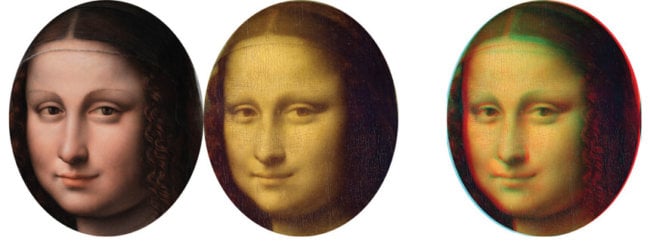
In his works, Leonardo da Vinci described monocular and binocular vision, and also studied the anatomy of the eye, the reflection of light, and even experimented with colored light sources. However, it is unclear whether he put both works together to understand the process of obtaining a three-dimensional image. Pictures from the Louvre and Prado do not create the perfect stereo pair, but show a very good result for that time. More than 500 years have passed since the writing of the Mona Lisa. This happened 330 years before the invention of the first stereogram. The device for viewing three-dimensional images was invented by Charles Wheatstone in 1838.
However, not everyone believes in the Mona Lisa 3D effect. Some experts believe that the picture from the Prado Museum and the original were created at different times. Gioconda harbors a lot of mysteries, which are unlikely to be able to find a definite answer.
Leonardo da Vinci is considered one of the greatest inventors in history. About his brilliant inventions can be found here.
The article is based on materials .
Comments
Post a Comment